




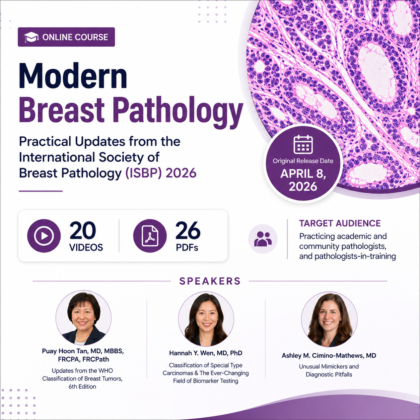


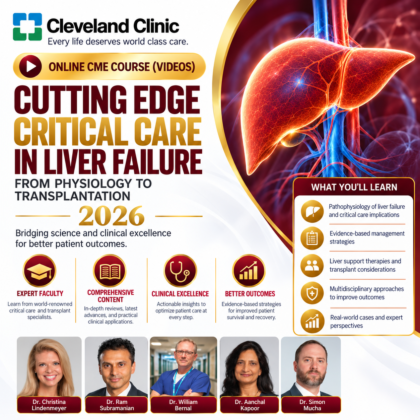
Cutting-Edge Critical Care in Liver Failure
From Physiology to Transplantation
🎥 Videos
💬 VTT Subtitle Files
📄 PDF
📦 Size: GB
📚 Course Information
Join us for the
Cutting-Edge Critical Care in Liver Failure: From Physiology to Transplantation,
July 6–7, 2026, in Hollywood, FL.
This symposium is a collaborative forum bringing together clinicians, educators, and trainees to
thoughtfully explore the care of critically ill patients with acute liver failure,
decompensated cirrhosis, and acute-on-chronic liver failure—from foundational physiology
through transplantation. Our goal is to emphasize evidence-based practice, interprofessional
collaboration, and practical bedside application.
✨ Why Attend?
This program provides a comprehensive exploration of critical care for patients with advanced liver
disease, combining foundational physiology with practical ICU management, transplant evaluation,
peri-transplant care, and multidisciplinary systems-based practice.
Understand core liver physiology and its role in recognizing and managing critical illness.
Explore evidence-based strategies for acute liver failure, ACLF, cirrhosis complications,
shock, renal failure, and organ support.
Integrate critical care stabilization with timely transplant referral and candidacy assessment.
Coordinate care across critical care, hepatology, transplant, anesthesia, nursing,
pharmacy, and allied health professionals.
🎯 Learning Objectives
By attending, participants will be able to:
-
Integrate core liver physiology with clinical syndrome recognition
(acute liver injury [ALI], acute liver failure [ALF], acute-on-chronic liver failure [ACLF],
and alcohol-associated hepatitis) to rapidly triage and manage critically ill liver patients,
applying evidence-based ICU strategies for complications of decompensated cirrhosis, including
variceal bleeding, spontaneous bacterial peritonitis, hepatic encephalopathy, and acute kidney injury. -
Implement a time-sensitive, integrated ICU management approach for acute liver failure prioritizing
golden-hour interventions utilizing evidence-informed neuromonitoring to prevent, detect and mitigate
cerebral edema and intracranial hypertension, initiating organ-specific support and extracorporeal
therapies as bridge to recovery or liver transplantation. -
Recognize and stage acute-on-chronic liver failure (ACLF) through systematic assessment of organ
failures and precipitating triggers, initiate prompt organ-specific management to prevent further
deterioration and expedite comprehensive transplant evaluation and referral to optimize candidacy
and survival. -
Differentiate hepatorenal syndrome (HRS) from other causes of acute kidney injury in cirrhosis,
guide targeted vasoconstrictor and volume therapies, and select appropriate mean arterial pressure
(MAP) targets and vasopressors for shock based on cirrhosis-specific hemodynamic physiology. -
Integrate ICU stabilization in parallel with transplant decision-making by identifying clinical
triggers for urgent transfer and transplant-center activation, implementing strategies to preserve
transplant candidacy during the critical window, and coordinating multidisciplinary consultation
across critical care, hepatology, and transplant services. -
Prioritize and risk-stratify liver transplant candidates by integrating ACLF severity and waitlist
mortality risk with comprehensive cardiac evaluation (including indications for combined cardiac–liver,
kidney transplant), frailty and sarcopenia assessment, and ethical frameworks for transplant candidacy,
including appropriate decision-making when transplantation is not indicated or feasible. -
Manage complex peri-transplant critical care differentiating and optimizing portopulmonary hypertension
versus hepatopulmonary syndrome to guide perioperative risk mitigation and coordinating care with
anesthesia for high-risk patients with cardiac comorbidities to reduce intraoperative and postoperative complications. -
Apply practical ICU strategies for advanced liver disease, balancing coagulopathy management with
procedural safety, implementing right-heart–protective strategies in portopulmonary hypertension,
and operationalizing standardized Liver ICU pathways to improve patient safety, efficiency, and outcomes.
👨⚕️ Who Should Attend?
This activity is designed for physicians, nurses, nurse practitioners, physician assistants,
social workers, pharmacists, fellows, residents, and other health care professionals who have
an interest in treating patients with liver failure in critical care.
Physicians
Nurses
Nurse Practitioners
Physician Assistants
Social Workers
Pharmacists
Fellows
Residents
Other Healthcare Professionals
📅 Topics & Program
From Physiology to Transplantation
Evidence-based education focused on acute liver failure, ACLF, decompensated cirrhosis,
hepatorenal syndrome, shock, extracorporeal therapies, neuromonitoring, transplant evaluation,
peri-transplant critical care, and multidisciplinary Liver ICU management.

Reviews
There are no reviews yet.