
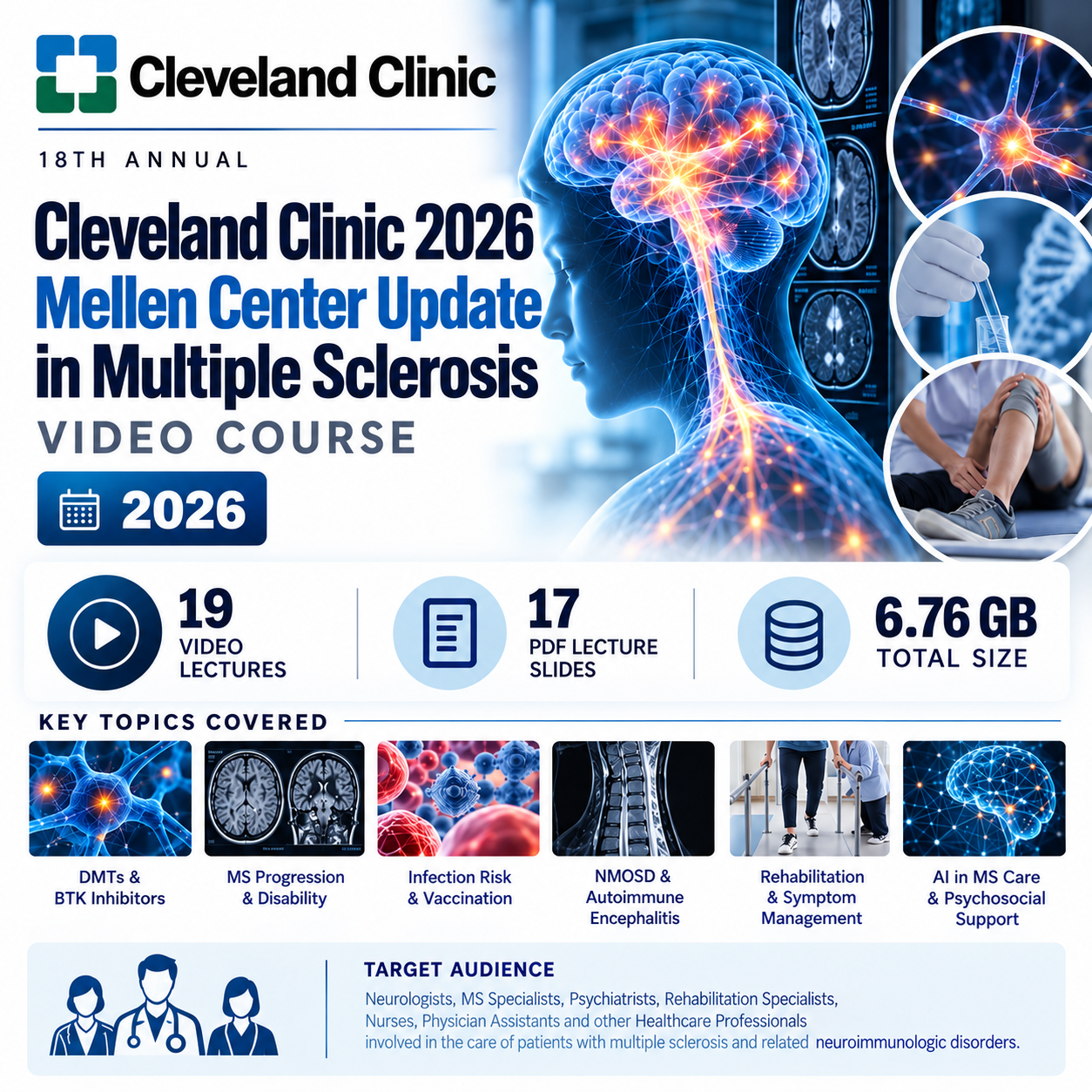







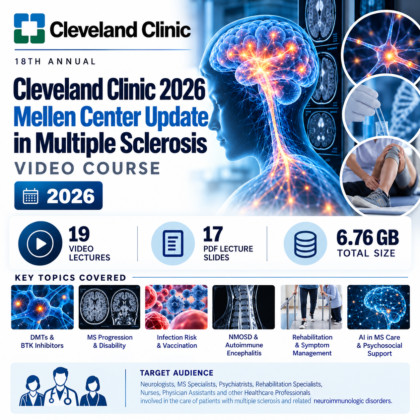
2026 Mellen Center Update in Multiple Sclerosis
18th Annual Multiple Sclerosis & Neuroimmunology Video Course
Video Lectures
Annual Symposium
No PDFs Included
COURSE OVERVIEW
About the Course
The Cleveland Clinic 2026 Mellen Center Update in Multiple Sclerosis is the 18th annual symposium from Cleveland Clinic, providing a comprehensive and forward-looking update on the latest advances in multiple sclerosis (MS), neuroimmunology, disease-modifying therapies, rehabilitation, and complex neurological disorders related to MS.
Directed by Devon Conway, MD, MS, the program brings together leading specialists to discuss emerging therapies, mechanisms of MS progression, infection risks associated with disease-modifying treatments, rehabilitation strategies, NMOSD, autoimmune encephalitis, hormonal influences, vaccination, and the expanding role of artificial intelligence in multiple sclerosis care.
Featured Topic: BTK Inhibitors
A major highlight of the 2026 program is an expert review of Bruton’s tyrosine kinase (BTK) inhibitors, including emerging Phase 3 evidence and their potential role in progressive multiple sclerosis.
PROGRAM OVERVIEW
🔬 Course Overview
The 2026 Mellen Center Update in Multiple Sclerosis combines clinically focused lectures with case-based discussions and interdisciplinary perspectives.
The course is designed to translate recent advances in MS research into practical approaches clinicians can use when managing patients with multiple sclerosis and related neuroimmunologic disorders.
Key Areas Covered
- Multiple sclerosis disease-modifying therapies
- BTK inhibitors and progressive MS
- Infection risks associated with DMTs
- MS progression and disability
- Neuromyelitis Optica Spectrum Disorder (NMOSD)
- Autoimmune encephalitis
- MS rehabilitation
- Cognitive fatigue
- Hormonal influences on MS
- Vaccination strategies
- Artificial intelligence in MS
- Psychosocial care
- Fatigue, heat intolerance and spasticity
- Wheelchair evaluation
- Social determinants of health
EMERGING THERAPIES
BTK Inhibitors in Multiple Sclerosis
One of the major highlights of the Cleveland Clinic MS Update 2026 is the session:
BTK Inhibitors in Multiple Sclerosis: Integrating Phase 3 Trial Evidence to Address Progressive Disease
Presented by Jiwon Oh
This session examines the evolving scientific and clinical evidence surrounding Bruton’s tyrosine kinase inhibitors in MS.
The presentation reviews emerging Phase 3 evidence and the potential implications of BTK inhibition for progressive multiple sclerosis and future disease management.
TREATMENT & MONITORING
Multiple Sclerosis Disease-Modifying Therapies
Modern MS treatment increasingly requires balancing disease control with the potential risks associated with long-term immunomodulatory therapy.
The program includes dedicated education on:
- MS disease-modifying therapies (DMTs)
- Infection risk profiles
- Practical infection-prevention strategies
- Managing infection risk in real-world clinical cases
- Treatment selection and monitoring
- Vaccination considerations
A dedicated case-based session examines managing infection risk with DMTs, providing practical clinical perspectives from multiple faculty members.
DISEASE MONITORING
MS Progression & Disability
The course examines the important challenge of recognizing and monitoring progression in patients with multiple sclerosis.
The session Multiple Sclerosis Progression: Early Recognition and Monitoring Strategies focuses on identifying progression and improving the clinical assessment of changing disability.
This complements the program’s broader discussion of progressive disease and emerging therapeutic strategies.
NEUROIMMUNOLOGY
Neuromyelitis Optica Spectrum Disorder — NMOSD
The 2026 symposium expands beyond conventional MS to include important related neuroimmunologic disorders.
Choosing First-Line Therapy in AQP4+ NMOSD—Practical Insights on New FDA-Approved Monoclonal Antibodies
The presentation focuses on practical considerations surrounding first-line treatment selection in AQP4-positive Neuromyelitis Optica Spectrum Disorder.
CLINICAL DIAGNOSIS
Autoimmune Encephalitis
Autoimmune Encephalitis: Practical Strategies for Diagnosis, Antibody Testing, and Treatment Sequencing provides a clinically focused review of this challenging neuroimmunologic disorder.
The session addresses three particularly important areas:
- Diagnosis
- Antibody testing
- Treatment sequencing
This broadens the course’s relevance for neurologists and clinicians managing complex autoimmune neurological disorders.
REHABILITATION & LONG-TERM CARE
Multiple Sclerosis Rehabilitation
Rehabilitation receives substantial attention in the 2026 Mellen Center program.
The course reviews:
- Tele-exercise
- Cognitive training
- Fatigue programs
- Cognitive fatigue
- Evidence-based pacing
- Goal-oriented rehabilitation
- Wheelchair evaluation and planning
- Management of heat intolerance
- Spasticity management
The program emphasizes an interdisciplinary approach to MS rehabilitation, incorporating both physical and psychosocial aspects of long-term care.
SYMPTOM MANAGEMENT
Fatigue, Heat Intolerance & Spasticity
A dedicated interdisciplinary session focuses on three common and challenging MS symptoms:
Fatigue • Heat Intolerance • Spasticity
The session examines practical strategies for managing these symptoms through coordinated interdisciplinary care.
Another presentation specifically addresses MS cognitive fatigue and evidence-based pacing strategies relevant to rehabilitation practice.
HORMONAL INFLUENCES
Hormones & Multiple Sclerosis
Multiple Sclerosis Hormone Modulation: Clinical Insights From Puberty to Menopause
This session examines the influence of hormonal changes across different stages of life and their clinical relevance in patients with MS.
INFECTION PREVENTION
Vaccination in Multiple Sclerosis
Vaccination can require additional consideration in patients receiving disease-modifying therapies.
The program includes a focused session on:
- Vaccination timing
- Vaccine prioritization
- Live-virus vaccine pitfalls
- Practical vaccination strategies in patients with MS
This topic complements the course’s broader discussion of infection prevention and DMT-associated infection risk.
EMERGING TECHNOLOGY
Artificial Intelligence in Multiple Sclerosis
The 2026 Mellen Center Update also examines one of the fastest-developing areas in modern medicine: artificial intelligence.
Integrating AI-Driven Insights in Multiple Sclerosis explores the expanding role of AI in healthcare and its potential impact on diagnosis, treatment, clinical decision-making, and patient outcomes.
INDIVIDUALIZED PATIENT CARE
Older Adults with Multiple Sclerosis
As the MS population ages, clinicians increasingly encounter challenges involving treatment transitions, rehabilitation, and psychosocial care.
The course includes a dedicated session covering:
- Older-adult MS
- Psychosocial care
- DMT transition
- Goal-oriented rehabilitation
PATIENT-CENTERED CARE
Men with Multiple Sclerosis
The program also addresses the needs of men living with MS, including:
- Patient engagement
- Coping strategies
- Quality-of-life support
This reflects the symposium’s broader emphasis on individualized and patient-centered MS care.
EQUITY IN HEALTHCARE
Social Determinants & Equity in MS Care
The course examines how social determinants can affect continuity and outcomes in multiple sclerosis care.
A dedicated presentation discusses practical strategies to minimize loss to follow-up and enhance equity for patients with MS.
COMPLETE VIDEO PROGRAM
Video Lectures & Faculty
Choosing First-Line Therapy in AQP4+ NMOSD—Practical Insights on New FDA-Approved Monoclonal Antibodies
25:49
Men with MS: Strategies for Engagement, Coping, and Quality-of-Life Support
07:11
Older-Adult MS: Interdisciplinary Strategies for Psychosocial Care, DMT Transition, and Goal-Oriented Rehabilitation
08:19
Multiple Sclerosis and Social Determinants: Practical Tactics to Minimize Loss to Follow-Up and Enhance Equity
06:29
Multiple Sclerosis Vaccination Strategies: Timing, Prioritization, and Live-Virus Pitfalls
19:46
Integrating AI-Driven Insights in Multiple Sclerosis
20:54
Multiple Sclerosis DMTs: Infection Risk Profiles and Practical Prevention Strategies
26:47
Multiple Sclerosis Case Studies: Managing Infection Risk with DMTs
29:11
Multiple Sclerosis Progression: Early Recognition and Monitoring Strategies
28:39
Multiple Sclerosis Hormone Modulation: Clinical Insights From Puberty to Menopause
23:18
BTK Inhibitors in Multiple Sclerosis: Integrating Phase 3 Trial Evidence to Address Progressive Disease
47:22
Multiple Sclerosis Rehabilitation Strategies: Key Takeaways on Tele-Exercise, Cognitive Training, and Fatigue Programs
34:37
Autoimmune Encephalitis: Practical Strategies for Diagnosis, Antibody Testing, and Treatment Sequencing
34:09
Multiple Sclerosis Cognitive Fatigue: Evidence-Based Pacing Strategies Every Rehab Clinician Should Know
30:12
Multiple Sclerosis Wheelchair Evaluation: Best Practices for Proactive Five-Year Coverage Planning
33:59
Multiple Sclerosis Symptom Triad: Interdisciplinary Strategies for Fatigue, Heat Intolerance, and Spasticity Management
34:34
EDUCATIONAL OUTCOMES
Learning Objectives
After completing the course, participants should be better prepared to:
Describe updates in MS disease-modifying therapies, including BTK inhibitors.
Understand and manage infection risks associated with DMTs.
Review recent treatment developments in NMOSD.
Apply practical approaches to autoimmune encephalitis.
Understand contemporary MS rehabilitation strategies.
Recognize mechanisms contributing to MS disability progression.
Understand hormonal influences on multiple sclerosis.
Apply interdisciplinary approaches to fatigue, heat intolerance, and spasticity.
Understand emerging applications of artificial intelligence in MS care.
Review vaccination considerations in patients with MS.
Address psychological and quality-of-life considerations.
Improve rehabilitation and mobility planning.
INTENDED AUDIENCE
Who Is This Course For?
The Cleveland Clinic 2026 Mellen Center Update in Multiple Sclerosis is designed for healthcare professionals involved in caring for patients with MS and related disorders, including:
Multiple Sclerosis Specialists
Neuroimmunologists
Physicians
Nurses
Physician Assistants
Advanced Practice Providers
Physical Therapists
Occupational Therapists
Speech Therapists
Rehabilitation Specialists
Psychologists
Other Healthcare Professionals Treating Patients with MS



Reviews
There are no reviews yet.